
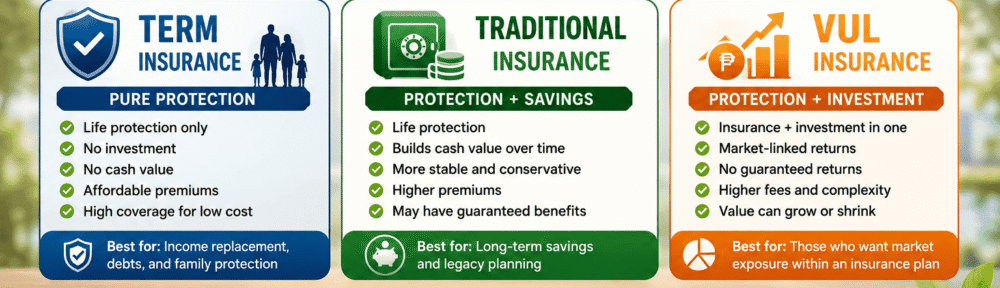
A lot of people get confused when choosing insurance in the Philippines because products are often bundled in a way that makes everything look “investment + protection.”
But in reality, there are only three core structures you need to understand:
- Term Insurance
- Traditional Insurance (Whole Life / Endowment)
- VUL (Variable Universal Life)
Once you understand how they differ, it becomes much easier to decide what actually fits your financial goal.
1. Term Insurance (Pure Protection)
Term insurance is the simplest form of life insurance.
You pay a premium for a specific coverage, and you are protected for a defined period or as long as you continue paying (for renewable types).
Key characteristics:
- Pure life protection only
- No investment component
- No cash value
- Very affordable compared to other types
- High coverage for low cost
Example use case:
If you want ₱1M to ₱5M protection for your family in case something happens to you, term insurance is the most efficient way to get it.
Important point:
Even if it is “renewable monthly or yearly,” it is still term insurance as long as:
- there is no savings
- there is no investment fund
- coverage exists only while premiums are paid
2. Traditional Insurance (Whole Life / Endowment)
Traditional insurance combines protection with a built-in savings component.
Key characteristics:
- Life insurance coverage (often long-term or lifetime)
- Builds cash value over time
- More stable and conservative growth structure
- Higher premiums compared to term insurance
- Some policies provide guaranteed or semi-guaranteed benefits depending on structure
What makes it different:
Unlike term insurance, traditional policies are designed so that part of your premium is allocated into a savings pool that grows over time.
Simple way to think about it:
You are paying for:
- Protection
- Plus forced long-term savings
3. VUL (Variable Universal Life)
VUL is where insurance and investing are combined into one product.
Part of your premium goes to:
- Life insurance cost
- Investment funds (stocks, bonds, or mixed portfolios)
Key characteristics:
- Insurance + investment in one policy
- Fund value depends on market performance
- No guaranteed returns
- Higher fees and complexity
- Can grow or shrink depending on market conditions
Important reality:
VUL is not just insurance. It is primarily an investment wrapper with insurance attached.
Side-by-Side Comparison
| Feature | Term | Traditional | VUL |
|---|---|---|---|
| Purpose | Protection only | Protection + savings | Protection + investment |
| Cost | Low | High | Medium to high |
| Cash value | None | Yes (stable/conservative) | Yes (market-based) |
| Investment exposure | None | Minimal/indirect | Direct (fund-based) |
| Complexity | Simple | Moderate | High |
| Risk level | Low | Low to moderate | Moderate to high |
The Real Problem in the Market
A lot of financial confusion comes from mixing two goals:
- Protection (insurance)
- Wealth building (investment)
These are often bundled into VUL products, making people think they are “getting the best of both worlds.”
In reality:
- You are paying higher fees for convenience
- Investment returns are not guaranteed
- Protection cost is indirectly affected by investment structure
Better Financial Approach (Most Practical Strategy)
A more efficient approach is separating the two goals:
Step 1: Get Term Insurance
- Focus on protection
- Choose enough coverage for income replacement, debts, and family needs
Step 2: Invest the difference
Instead of paying higher premiums for bundled products, invest the savings separately into:
- Pag-IBIG MP2
- Mutual funds
- ETFs or stock market investments
- Feeder funds like those under ATRAM
This approach is commonly known as:
Buy Term, Invest the Difference (BTID)
Blogger’s Corner
This is where I’ll be direct based on experience and observation.
For my personal preference, I strongly lean toward term insurance, specifically health insurance with free life insurance riders.
The reason is simple: insurance should be about protection, not investment.
If the goal is purely insurance, then VUL should not even be part of the discussion. It adds complexity, higher costs, and mixes two goals that are better handled separately.
If the goal is both insurance and investment, the more practical approach is to:
- Get a proper term insurance plan for protection
- Then invest separately in structured vehicles like Pag-IBIG MP2 or diversified funds such as ATRAM Global Feeder Funds and similar instruments
This separation keeps things clearer, more flexible, and often more cost-efficient in the long run.
Insurance protects your downside. Investing builds your upside. Combining them in one product often weakens both.