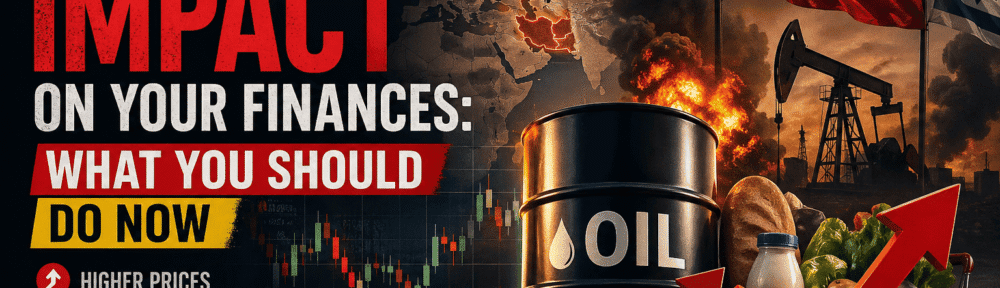
If a war in the Middle East feels distant, it shouldn’t.
You are already paying for it.
Not directly, but through higher fuel prices, rising food costs, and increasing uncertainty in the global economy.
And this may only be the beginning.
Let’s break down what’s happening and what you should actually do about it.
What’s Happening Right Now
The ongoing conflict involving Iran and major global powers has disrupted one of the most critical systems in the world economy.
Energy.
Iran sits near the Strait of Hormuz, a narrow passage where a significant portion of the world’s oil supply moves through daily. Any threat in this area immediately affects global oil prices.
When tensions rise, oil prices react quickly.
And when oil prices go up, almost everything else follows.
Why?
Because oil is deeply embedded in the global economy:
- Transportation and logistics
- Electricity generation in many countries
- Manufacturing and industrial production
- Agriculture and food distribution
Even if you never think about oil, your daily expenses are tied to it.
Why This Matters More Than People Expect
Most people assume wars only affect the countries directly involved.
That’s outdated thinking.
Modern economies are interconnected. A disruption in one region spreads quickly across the globe.
Here’s how this plays out:
1. Inflation Gets Worse
Higher oil prices increase the cost of transporting goods and producing them.
Companies pass those costs to consumers.
That means:
- More expensive groceries
- Higher utility bills
- Increased cost of services
Even countries far from the conflict feel this almost immediately.
2. Central Banks Stay Aggressive
If inflation rises again, central banks may delay interest rate cuts or even tighten further.
That affects:
- Loan interest rates
- Credit card debt
- Mortgage affordability
- Business expansion
In short, money becomes more expensive.
3. Markets Become Volatile
Uncertainty is bad for markets.
During geopolitical conflicts, investors tend to move money into safer assets and away from risk.
This leads to:
- Stock market swings
- Currency fluctuations
- Sudden price drops or spikes
For long term investors, this can create opportunity. For unprepared investors, it creates panic.
4. Global Growth Slows Down
When energy becomes expensive, businesses spend more just to operate.
That reduces profits and slows down expansion.
Over time, this leads to:
- Slower job creation
- Reduced wage growth
- More cautious consumer spending
It does not cause an instant recession, but it increases the risk.
The Bigger Risk Nobody Talks About
The war itself is not the only issue.
The real risk is escalation.
If the conflict disrupts oil supply routes or pulls in more countries, the impact could multiply quickly.
That’s when you see:
- Sharp spikes in oil prices
- Severe inflation shocks
- Market downturns
- Global economic slowdown
This is why markets react not just to what is happening, but to what might happen next.
What You Should Actually Do Right Now
You cannot control geopolitics.
But you can control how exposed you are to its effects.
Here are practical steps that make sense in this environment.
1. Strengthen Your Cash Position
Uncertainty rewards liquidity.
Having cash or easily accessible savings gives you flexibility when conditions change.
It allows you to:
- Handle rising expenses
- Avoid high interest debt
- Take advantage of opportunities during market dips
If your finances are tight, this should be your first priority.
2. Prepare for Higher Living Costs
Assume that prices will rise before they stabilize.
Instead of reacting late, adjust early:
- Review recurring expenses
- Cut non essential spending
- Improve energy efficiency where possible
Small adjustments now prevent bigger problems later.
3. Avoid Overleveraging
This is not an ideal environment to take on large amounts of debt.
When uncertainty increases, stability becomes more important than expansion.
Be cautious with:
- Large loans
- Big purchases that depend on future income
- Financial decisions that reduce your flexibility
4. Stay Invested, But Stay Disciplined
Geopolitical tension creates volatility, not necessarily long term destruction.
Historically, markets recover from conflicts. But the timing is unpredictable.
A balanced approach works best:
- Stick to long term strategies
- Avoid panic selling
- Do not chase short term trends
Volatility can be useful, but only if you remain consistent.
5. Focus on Income Stability
Expenses rising is only half the problem.
Income uncertainty is the other half.
If possible:
- Strengthen your main source of income
- Build additional income streams
- Improve skills that increase earning potential
Financial resilience comes from both saving and earning.
6. Think in Scenarios, Not Predictions
Trying to predict exactly what will happen is a mistake.
Instead, think in scenarios:
- If inflation rises, what changes?
- If markets drop, what will you do?
- If your expenses increase significantly, are you ready?
Preparation beats prediction every time.
Blogger’s Corner
Global conflicts have a way of exposing financial weaknesses.
Not just in economies, but in personal finances.
The Iran war is a reminder that your financial life is connected to events far outside your control.
You do not need to panic.
But ignoring it is not a strategy either.
The people who come out of situations like this in a stronger position are not the ones who predict the future correctly.
They are the ones who prepare for uncertainty.
So the real question is simple.
If things get more expensive, more volatile, and more unpredictable from here, are you ready for it?