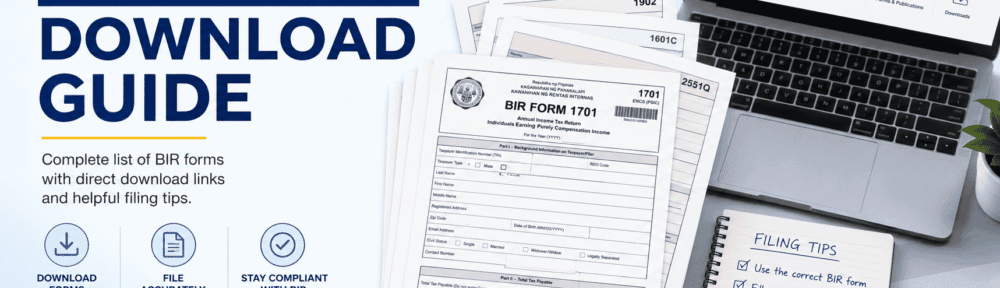
If you’ve ever needed to file your taxes, apply for business registration, or simply request your annual ITR, you know how important BIR forms are. The Bureau of Internal Revenue (BIR) requires different forms depending on whether you’re an employee, self-employed, or running a business.
To save you time, I’ve compiled a list of the most commonly used BIR forms, along with direct download links from the official BIR website.
What Are BIR Forms?
BIR forms are official documents issued by the Bureau of Internal Revenue for taxpayers in the Philippines. These forms are used for filing taxes, registering businesses, updating records, and requesting certifications.
Instead of lining up at the BIR office just to get one, you can now download most BIR forms online for free.
List of Commonly Used BIR Forms (with Download Links)
Here’s a breakdown of the most requested BIR forms:
1. BIR Form 2316
- What it is: Certificate of Compensation Payment/Tax Withheld (usually issued by your employer every January).
- Who needs it: Employees for ITR filing or loan applications.
- Download link: BIR Form 2316 (PDF)
2. BIR Form 1701
- What it is: Annual Income Tax Return for Individuals (including Mixed Income Earners), Estates, and Trusts. This is the most comprehensive ITR form for individual taxpayers with business or professional income.
- Who needs it: Self-employed individuals, professionals, and mixed income earners (those with both compensation and business/professional income) classified as Medium (gross sales of ₱20,000,000 to less than ₱1,000,000,000) or Large (gross sales of ₱1,000,000,000 and above) taxpayers.
- If your gross sales are below ₱20M, you may qualify for the simpler BIR Form 1701-MS instead.
- Download link: BIR Form 1701 (PDF)
3. BIR Form 1701A
- What it is: Annual Income Tax Return for Individuals Earning Income Purely from Business or Profession. A simpler version of Form 1701 — but only for those with no compensation income on the side.
- Who needs it: Self-employed individuals and professionals with purely business or professional income (no employer, no salary) who are classified as Medium or Large taxpayers, or those availing of the 8% flat income tax rate regardless of size.
- If your gross sales are below ₱20M, check if BIR Form 1701-MS applies to you instead.
- Download link: BIR Form 1701A (PDF)
4. BIR Form 1701-MS
- What it is: Annual Income Tax Return for Individuals Classified as Micro or Small Taxpayers. Introduced under the Ease of Paying Taxes (EOPT) Act (RA 11976) as a simpler alternative to Form 1701/1701A for smaller taxpayers.
- Who needs it: Freelancers, self-employed professionals, and small business owners classified as Micro (gross sales below ₱3,000,000) or Small (gross sales of ₱3,000,000 to less than ₱20,000,000). Also applies to mixed income earners in those brackets.
- Download link: BIR Form 1701-MS (PDF)
5. BIR Form 1901
- What it is: Application for Registration for Self-Employed and Mixed Income Individuals, Estates, and Trusts.
- Who needs it: Freelancers, professionals, or business owners registering for the first time.
- Download link: BIR Form 1901 (PDF)
6. BIR Form 0605
- What it is: Payment Form for taxes that are due but not connected to regular tax returns.
- Who needs it: Taxpayers paying annual registration fee or penalties.
- Download link: BIR Form 0605 (PDF)
7. BIR Form 2551Q
- What it is: Quarterly Percentage Tax Return.
- Who needs it: Self-employed and small businesses not subject to VAT.
- Download link: BIR Form 2551Q (PDF)
8. BIR Form 1601C
- What it is: Monthly Remittance Return of Income Taxes Withheld on Compensation.
- Who needs it: Employers who remit withholding taxes for employees.
- Download link: BIR Form 1601C (PDF)
9. BIR Form 2307
- What it is: Certificate of Creditable Tax Withheld at Source.
- Who needs it: Freelancers and professionals who had taxes withheld by clients.
- Download link: BIR Form 2307 (PDF)
10. BIR Form 1701Q
- What it is: Quarterly Income Tax Return for Individuals, Estates, and Trusts. This is the form used to declare income earned and taxes due for each quarter of the year. Think of it as your “progress report” to the BIR — you file this three times a year, then settle everything with your annual ITR (1701, 1701A, or 1701-MS) at year-end.
- Who needs it: Freelancers, sole proprietors, online sellers, consultants, self-employed professionals (doctors, lawyers, architects, accountants, etc.), and mixed income earners — those with both employment and business or professional income. Pure employees with no side business do NOT need to file this. Important: you must file even if you had zero income for the quarter, as long as you are actively registered with the BIR as a self-employed or business taxpayer.
- Filing deadlines:
- Q1 (January–March): on or before May 15
- Q2 (April–June): on or before August 15
- Q3 (July–September): on or before November 15
- (No Q4 filing — that’s covered by your annual ITR)
- Download link: BIR Form 1701Q (PDF)
Where to Find Other BIR Forms
The list above only covers the most commonly used forms. If you need other forms (like VAT forms, excise tax, or estate tax), you can check the full library here:
Final Notes
Filing taxes can be stressful, but at least downloading the right BIR forms shouldn’t be. Bookmark this page or download the forms you’ll need ahead of time so you won’t have to worry when deadlines come around.
If you’re an employee, make sure to keep your BIR Form 2316 for future use. And if you’re self-employed or a freelancer, forms like 1701, 1701A, and 0605 will be your best friends every tax season.
Blogger’s Corner
When I first registered as self-employed, the hardest part wasn’t the paperwork itself—it was figuring out which forms to use. BIR has dozens of them, and it can get overwhelming. That’s why I made this guide: so you don’t waste hours looking for the right download link.
Remember: taxes may not be fun, but paying them right saves you bigger headaches in the future.