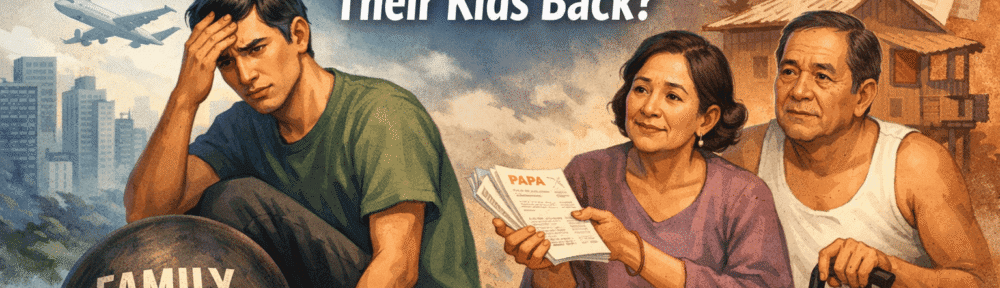
In the Philippines, family is everything.
We’re raised to respect our parents, support our siblings, and give back once we start earning.
On paper, that sounds noble.
But here’s a question not many people are willing to ask.
What if this culture is quietly holding people back financially?
Let’s talk about it.
The Reality of Being a Breadwinner
For many Filipinos, the moment they get their first job, they don’t just gain income.
They gain responsibility.
Suddenly, they’re expected to help with:
- Household bills
- Siblings’ tuition
- Groceries
- Medical expenses
- Even extended family needs
And this isn’t optional.
It’s expected.
“Utang na Loob” and Financial Pressure
One of the strongest cultural values in the Philippines is “utang na loob.”
It means you owe your parents for raising you.
Again, nothing wrong with gratitude.
But the problem starts when it becomes a lifelong financial obligation.
Instead of building their own future, many young professionals end up:
- Supporting the entire household
- Delaying their own savings
- Postponing investments
- Avoiding risks like starting a business
Not because they’re irresponsible.
But because they don’t have a choice.
When Support Becomes Dependence
Helping your family is not the issue.
The issue is when support turns into dependence.
Some common scenarios:
- Parents relying fully on their children for retirement
- Siblings not being encouraged to become financially independent
- Families maintaining lifestyles beyond what they can afford
In these cases, the financial burden doesn’t go away.
It grows.
The Hidden Cost: Delayed Financial Freedom
Let’s be real.
Every peso you give away is a peso you can’t:
- Save
- Invest
- Use to build your own life
This leads to:
- Late emergency funds
- Delayed investing
- Slower wealth building
- Increased stress and burnout
By the time some Filipinos are ready to focus on themselves, they’re already in their 30s or 40s.
And they’re starting from scratch.
Is It Really the Parents’ Fault?
This is where things get uncomfortable.
It’s easy to blame parents.
But the reality is more complicated.
Many Filipino parents:
- Didn’t have access to financial education
- Didn’t earn enough to save for retirement
- Sacrificed everything for their children
So they rely on the only safety net they know.
Their kids.
This isn’t always intentional.
Sometimes, it’s survival.
The Cycle That Keeps Repeating
Here’s the bigger issue.
This pattern repeats across generations.
Parents rely on children
Children grow up and do the same
Then their children repeat it again
Without intervention, the cycle never ends.
Breaking the Cycle (Without Being Disrespectful)
You don’t have to choose between your family and your future.
But you do need boundaries.
Here are practical steps:
1. Set a Fixed Support Amount
Help your family, but within limits.
Treat it like a budget, not an open wallet.
2. Prioritize Your Own Stability
Before increasing support, make sure you have:
- Emergency fund
- Basic savings
- Financial breathing room
You cannot pour from an empty cup.
3. Encourage Independence
This is the hardest part.
But it’s necessary.
Encourage siblings to work
Promote financial responsibility at home
Support should not mean permanent dependence.
4. Have Honest Conversations
Not easy, but important.
Set expectations early.
The longer you delay this, the harder it becomes.
The Unpopular Truth
Being a good child does not mean sacrificing your entire financial future.
And building your own life does not mean you don’t care about your family.
You can do both.
But only if you’re intentional.
Blogger’s Corner
Filipino family culture is powerful.
It creates strong support systems.
But it can also create silent pressure.
If you feel like you’re falling behind financially because of family responsibilities, you’re not alone.
The goal is not to abandon your family.
It’s to break the cycle so the next generation doesn’t have to go through the same struggle.