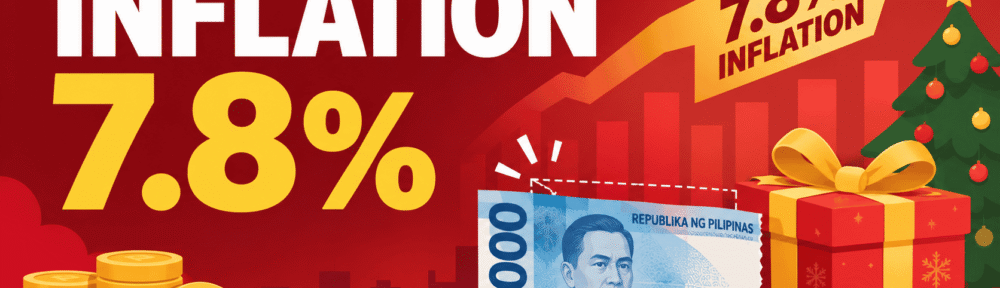
The 13th month pay is the biggest single cash boost many Filipino workers get all year, and it arrives at a rough time. Inflation hit 7.8% in October 2026, the fastest pace since February 2023, and the BSP has raised its policy rate four times in a row to 5.50%. Every peso in your bonus buys less than it did a year ago, and it will buy even less if it just sits idle. This guide covers how the 13th month pay is computed, how much of it is tax-free, and the realistic ways to protect it.
How 13th Month Pay Works
Under Presidential Decree No. 851 and the Labor Code, rank-and-file employees in the private sector are entitled to the 13th month pay regardless of position, employment status, or how their wages are paid, as long as they worked at least one month during the calendar year. The minimum is 1/12 of your total basic salary earned within the calendar year.
Employers must release it on or before December 24, and DOLE has said it will not accept requests for exemption or deferment. It can be paid in two installments (one mid-year, one in December) as long as the full amount is out by December 24. Employers then submit a compliance report to DOLE by January 15.
At the time of writing, I could not find DOLE’s 2026 labor advisory yet. DOLE usually issues it in November, and the most recent one I could verify is Labor Advisory No. 16, Series of 2025, so check DOLE for the 2026 version once it is out.
Here is how the computation works in practice:
- An employee with a ₱25,000 monthly basic salary who worked all 12 months gets (₱25,000 × 12) ÷ 12 = ₱25,000.
- A new hire earning ₱20,000 who started in June and worked 7 months gets (₱20,000 × 7) ÷ 12 = ₱11,666.67.
Only basic salary counts. Allowances and other benefits are generally excluded unless your contract or company policy says otherwise. To see how your December take-home pay changes, try the net salary calculator.
Is the 13th Month Pay Taxable?
Your 13th month pay and other benefits (Christmas bonus, productivity incentives and similar) are tax-exempt up to a combined ₱90,000 under the TRAIN Law. Anything above that is added to your taxable compensation income.
For example, if you receive a ₱70,000 13th month pay and a ₱30,000 Christmas bonus, the total is ₱100,000, so ₱10,000 is taxable.
Bills to raise the ceiling have been filed in the House (House Bill 3784 proposes ₱120,000, and House Bill 7661 proposes ₱150,000). As of November 7, 2026, I found no sign that either has been enacted, so the ₱90,000 ceiling still applies.
Why 7.8% Inflation Changes the Math
The Philippine Statistics Authority reported that October inflation rose to 7.8% from 7.2% in September. Core inflation, which excludes volatile food and energy items, jumped to 5.4%. Transport costs are up 20.1% year on year, and rice inflation is at 20.7%. For January to October, inflation averaged 5.6%, well above the government’s 2 to 4 percent target.
It may not ease soon. Chinabank Research expects inflation to peak just above 8% in November, with core inflation staying above 5% until the first quarter of 2027. BSP Governor Eli Remolona Jr. has signaled that rate cuts are still some way off, and the peso has been setting record lows, breaching ₱64 to the dollar in late October.
Here is what that means for idle cash. If prices keep rising at 7.8% for a year, a ₱20,000 bonus kept at zero return loses about ₱1,450 in buying power, and ₱50,000 loses about ₱3,600. That is an illustration, not a forecast, but it shows why “I’ll just keep it in the wallet” is expensive right now.
For the bigger picture on the rate hikes, see our inflation and BSP rate hike article.
Step 1: Cover Christmas and January First
Before chasing returns, set aside what you will actually spend between now and the end of January. That includes Noche Buena, gifts, school fees, and bills that tend to pile up after the holidays. Money you need within a few months should not go into anything with a lock-in period.
Here is one way to slice a ₱30,000 13th month pay, as a sample only:
- ₱12,000 for December and January expenses
- ₱9,000 to your emergency fund
- ₱6,000 to pay down expensive debt or start a longer-term product
- ₱3,000 for yourself (you earned it)
Your own split depends on your debts, dependents, and goals.
Step 2: Decide Where the Rest Can Work for You
None of these options is perfect, so here are the trade-offs.
Bank savings and time deposits
Convenient and PDIC-insured, but interest on bank deposits is subject to a 20% final tax. A time deposit advertised at 6% gross works out to about 4.8% net. Check your bank’s current rate, because most regular savings accounts pay far less than inflation.
Pag-IBIG MP2
The MP2 dividend for 2025 was 7.12%, announced by Pag-IBIG on February 27, 2026, and MP2 earnings are tax-free according to the Department of Finance. There are two catches. The dividend is declared after the year ends, so it is not a guaranteed rate, and the term is five years, so it only suits money you will not need. Read our article on whether Pag-IBIG MP2 is safe before putting a big amount in.
Government securities (T-bills and RTBs)
Backed by the national government, and yields have moved up with the BSP’s rate hikes. The BSP policy rate is 5.50%, and the 2-year government bond yield was around 7.33% as of November 2, according to the Asian Development Bank’s market data. Those are gross yields before tax. T-bill auction results are posted weekly by the Bureau of the Treasury, so check the latest 91-, 182-, and 364-day averages before buying. If the BSP hikes again, prices of existing bonds can fall, which only matters if you sell before maturity. Our Retail Treasury Bonds guide walks through how to buy.
Money market funds
Good for parking cash you may need in a few months, since they are generally liquid. Returns are not guaranteed and the funds are not PDIC-insured, so read the fund’s fact sheet first.
Paying down expensive debt
Paying off a credit card or other high-interest loan is a guaranteed return equal to the interest rate you stop paying. For many people with revolving balances, this beats every product above.
A Reality Check on Returns
Notice that even the best low-risk options above hover around 7%, roughly the same as inflation. That is not a reason to give up. Inflation is a moving number, and the goal right now is to keep your purchasing power from shrinking, not to get rich on one bonus. Beating inflation with low-risk products is hard, which is why spreading money across a few options and avoiding losses matters more than finding a perfect yield.
Mistakes to Avoid
Locking everything into a five-year product. If you may need cash in January, keep some liquid.
Chasing a high rate without checking the risk. If an offer promises returns far above the options above, be skeptical.
Forgetting about tax. Compare net returns, not advertised rates.
Not checking your computation. Compare what you received against 1/12 of your total basic salary, and call DOLE Hotline 1349 if your employer underpays or does not pay.
What to Watch Next
Watch the PSA’s third quarter growth report on November 9, the November inflation print in early December, and whether the BSP delivers another hike at its December meeting. Chinabank Research sees a possible 25 basis point hike. DOLE’s 2026 labor advisory on the 13th month pay should also appear this month.
Frequently Asked Questions
When is the deadline for the 13th month pay?
On or before December 24. Employers may split it into two installments, but the full amount must be released by the deadline.
Who is entitled to it?
Rank-and-file private sector employees who worked at least one month in the calendar year. Managerial employees are generally not covered by the law, although many companies give it anyway.
How is it computed?
Total basic salary earned in the year divided by 12. Employees who did not work the full year get a pro-rated amount, including those who resigned.
Is the 13th month pay taxable?
Not up to ₱90,000, combined with other benefits such as Christmas bonuses and productivity incentives. The excess is taxable.
Will the ₱90,000 tax-free ceiling go up?
Bills proposing ₱120,000 and ₱150,000 are pending in the House. I found no sign that either has been enacted as of November 7, 2026.
What if my employer does not pay?
Report it to DOLE. The DOLE Hotline 1349 is available 24/7.
Should I put all of it in MP2?
Not necessarily. MP2 has a five-year term, so keep money you may need soon somewhere more liquid.
Blogger’s Corner
Kuya Well here. Aminin natin, every December we all tell ourselves na “this year, ililipat ko agad sa ipon ang 13th month ko,” tapos Christmas sales happen. This year the stakes are higher, kasi inflation is eating the value of whatever we leave sitting around. My own rule is simple: cover the expenses I already know are coming, then decide where the rest goes before the money hits my account, not after. You don’t need a perfect plan, you just need a plan.
This article is for educational purposes only and is not financial, tax, or legal advice. Rates, rules, and tax treatment can change, so verify details with the official sources and your own advisor before making decisions.